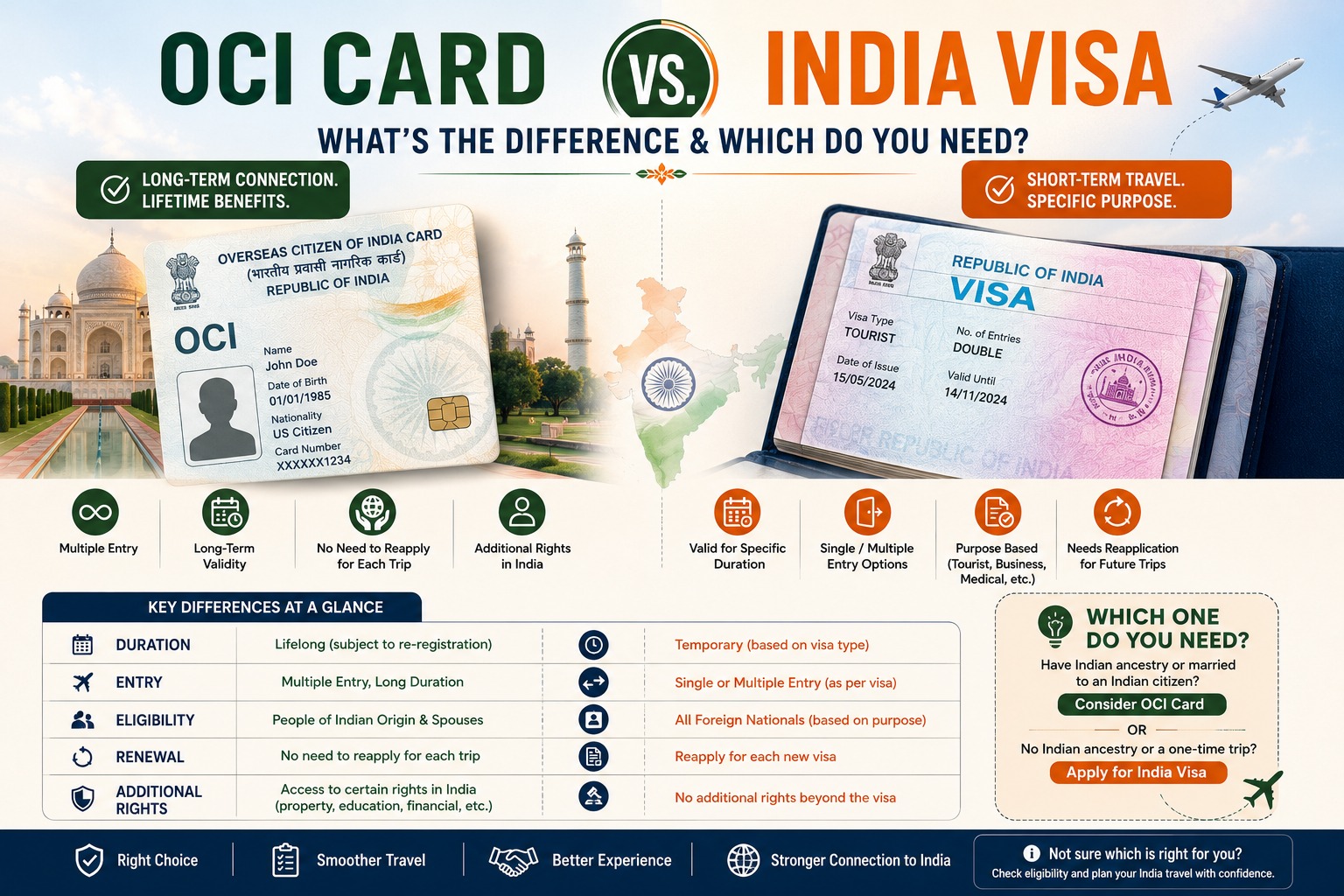
OCI Card vs. India Visa: What's the Difference & Which Do You Need?
If you're a US citizen of Indian origin — or married to one, or a US-born child of Indian parents — you've probably come across the term "OCI card" while researching how to travel to India. It's often mentioned alongside visas, but it's a genuinely different thing, with different eligibility rules, different benefits, and a different application process. Mixing the two up is one of the most common points of confusion for the Indian-American community planning a trip. Here's a clear breakdown of what each one actually is.
What Is an India Visa?
A visa is a temporary authorization to enter India for a specific purpose — Tourist, Business, Medical, Student, or Ayush — and for a specific, limited duration. It's the standard pathway for the vast majority of foreign nationals, including most US citizens without Indian ancestry, traveling to India.
What Is an OCI Card?
An Overseas Citizen of India (OCI) card is a long-term immigration status — not a visa in the traditional sense — available to certain people of Indian origin (and their spouses, in some cases) who hold foreign citizenship. It's not the same as dual citizenship, since India doesn't allow that, but it does provide something visas don't: a largely visa-free, multiple-entry, lifelong (subject to periodic re-registration in some cases) travel status for India.
Who Is Eligible for an OCI Card?
Broadly, OCI eligibility extends to:
Foreign nationals who were Indian citizens at some point, or eligible to become one at the time of India's independence
Children and grandchildren of the above
Spouses of Indian citizens or OCI cardholders, subject to specific conditions Eligibility rules have specific documentation requirements — proof of the ancestral connection to India, such as an old Indian passport, a parent's birth certificate, or similar records — so this isn't a status just anyone with a general interest in India can apply for.
Key Differences at a Glance
Duration: A visa is temporary and tied to a specific purpose and stay length. An OCI card is a long-term status that doesn't require repeated visa applications for future trips.
Entry Type: Most India visas restrict how many times and for how long you can enter during their validity. OCI cardholders generally get multiple-entry, long-duration travel benefits without needing to reapply before each trip.
Eligibility Basis: Visas are available to virtually any foreign national who applies and qualifies under a given category. OCI cards are only available to those with an Indian ancestral or marital connection meeting specific criteria.
Renewal: Visas need to be reapplied for each time you plan to travel (unless you hold a longer multiple-entry visa still within its validity). OCI cards, once issued, generally don't require a new application for every trip, though periodic updates to the OCI document itself may be required (for example, when your passport is renewed).
Rights Beyond Travel: OCI status also carries certain rights beyond travel — such as easier access to some financial and property transactions in India — that a standard visa doesn't provide. It's still not equivalent to Indian citizenship, and there are specific activities (like voting or holding certain public offices) that OCI status doesn't permit.
Which One Do You Actually Need? If you have no Indian ancestry or family connection through marriage, this decision is straightforward — you'll apply for a visa under the category matching your purpose of travel. If you do have an Indian ancestral or marital connection and expect to travel to India more than once, or want to avoid reapplying for a new visa every trip, it's worth seriously looking into OCI eligibility. The upfront documentation process is more involved than a standard visa application, but it removes the need to repeat the process for future travel. If you're planning a single trip in the near term and OCI eligibility isn't clearly established yet, applying for the appropriate visa category for that specific trip is usually the more practical near term path, with OCI as something to pursue afterward if it fits your longer-term travel plans.
Common Misconceptions
"OCI means I'm still an Indian citizen." Not accurate — India does not permit dual citizenship, and OCI status is a distinct long-term visa-like status, not citizenship.
"I don't need any documentation to prove my Indian origin." Also inaccurate — OCI applications require specific supporting documents proving your ancestral or marital connection, and incomplete documentation is a common cause of delayed applications.
"OCI cardholders can enter India with no restrictions at all." OCI status removes the need for a separate visa for most purposes, but it's not entirely unconditional — certain areas (like some border or protected regions) may still require special permits regardless of OCI status.
Frequently Asked Questions
Can a spouse who isn't of Indian origin get an OCI card? Yes, in many cases — spouses of Indian citizens or existing OCI cardholders may be eligible, subject to marriage duration and documentation requirements.
Does an OCI card expire? The OCI document itself is generally tied to your passport, and it typically needs to be updated when you get a new passport, particularly around certain age milestones.
Can I apply for a visa instead of OCI if I qualify for both? Technically, in some circumstances, yes — but if you qualify for OCI and plan to travel to India more than once, OCI generally offers more convenience over the long run than repeatedly applying for visas.
Is the OCI application process similar to an e-Visa application? Not exactly. It involves more extensive documentation to establish ancestral or marital eligibility, and processing can take longer than a standard Tourist e-Visa application.
The Bottom Line
A visa and an OCI card solve different problems. A visa gets you into India for a specific trip and purpose. An OCI card, available only to those with a qualifying Indian connection, offers a long term travel status that removes the need to repeat that process for every future visit. Knowing which one actually applies to your situation — before you start gathering documents — saves real time and effort down the line.
Not sure whether you qualify for OCI or need a standard visa? Reviewing your specific situation before applying can save you from starting the wrong process.


